

Within Health in Justice, our bespoke Health and Wellbeing Approach — underpinned by our vision of promoting people-centred care — ensures individuals receive the right support, in the right way, based on their unique needs.
At the heart of this approach is a commitment to working with people to understand their needs, goals and priorities across six key domains:
- Physical health
- Mental health
- Substance misuse
- Social circumstances including relationships and care needs
- Safety
- Continuity of care (transfer between services, resettlement from prison/IRC, deportation or removal)
This is delivered via our integrated pathways approach, which follows the person through every stage of their journey. By integrating care across these areas, we ensure a holistic and tailored approach that empowers individuals, improves wellbeing, and proactively manages risk.
Putting people in control of their own health
Traditionally, people in secure settings only came into contact with healthcare services at a point of crisis. Our approach is different. We work with individuals to understand the deeper issues behind their behaviour and health, helping them to develop personalised goals and the self-awareness to work towards them. Progress is owned by the person, and their care plan can be shared with whoever they choose, including prison and probation staff.
Life beyond custody
Recovery doesn’t stop at the prison gate. Our approach looks beyond the immediate setting, supporting continuity of care for people leaving a secure setting.
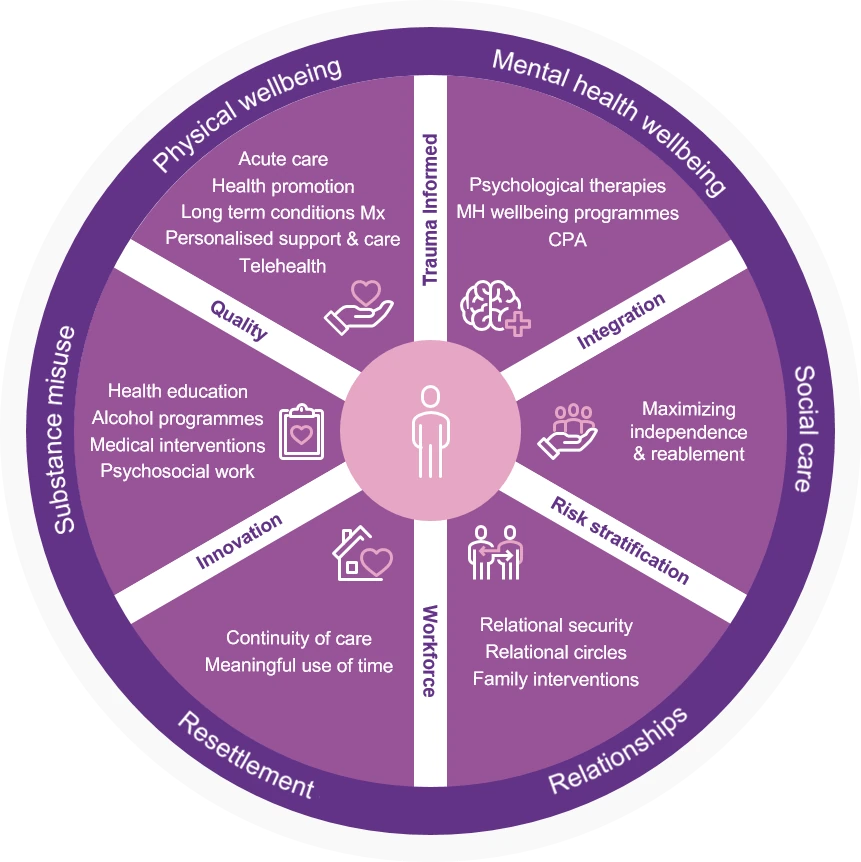
Our approach in practice: The Wellbeing Wheel
At the centre of our Health and Wellbeing Approach is a structured, person-led framework that maps an individual’s needs, goals and progress across six domains: physical wellbeing, mental health promotion, social care, relationships, resettlement and transfer, and substance misuse.
Within each domain, our multidisciplinary teams deliver targeted, evidence-based interventions — from acute care, health promotion and telehealth in physical wellbeing, to referral for mental health interventions and wellbeing programmes, dependency support and reablement in social care, and continuity of care and empowering self-care in resettlement and transfer.
The approach is underpinned by five core principles:
- Integrated approach – all services work together to ensure awareness of people with the highest level of need, enabling targeted interventions
- Tackling health inequalities – considering more than just presenting issues, including where someone has been living or how language barriers impact access
- Making every contact count – when people arrive for appointments, we identify whether we can support them with anything else while they are there
- No wrong door – a single application form, triaged to ensure the right care at the right time by the right clinician
- Trauma-informed approach – a prison-wide approach in partnership with the prison provider, with all staff trained to deliver psychologically informed care
Because the approach is owned by the individual, it travels with them if they are transferred to another location and can act as a health passport on release — supporting continuity of care as they re-engage with community health and social services.